TR Vmax

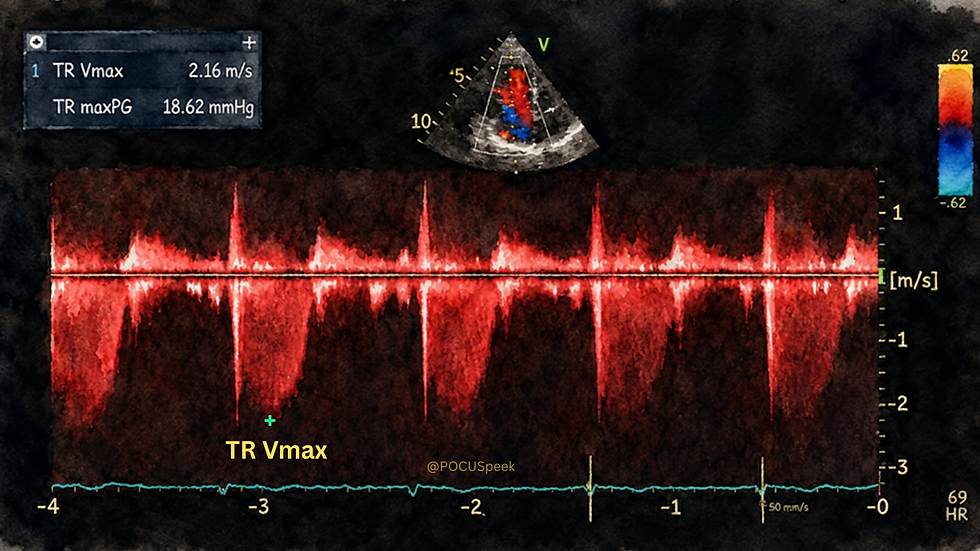
When left atrial pressure / LV filling pressure is chronically or significantly raised, pressure backs up in this direction:
LV filling pressure ↑ → LA pressure ↑ → pulmonary venous pressure ↑ → pulmonary artery pressure ↑ → RV systolic pressure ↑ → TR velocity ↑
So TR velocity is not measuring LV pressure directly. It is telling you that the right side is now “seeing” the consequences of high left-sided pressures through the pulmonary circulation
In diastolic assessment, a raised TR velocity, classically >2.8 m/s, supports raised LV filling pressure when it fits with the rest of the picture: high E/e′, enlarged LA, abnormal mitral inflow, pulmonary venous changes, etc
The key teaching line is:
TR velocity is a late/downstream marker: it suggests that raised left-sided filling pressure has transmitted backwards enough to increase pulmonary artery pressure
Important caveat: TR velocity can be high for non-left-heart reasons, such as primary pulmonary hypertension, chronic lung disease, PE, RV disease, significant TR, or poor Doppler alignment. So it should never be interpreted alone. The BSE pulmonary hypertension guidance treats TR velocity as part of estimating probability of pulmonary hypertension, not as a standalone diagnosis.
Assuming no RV outflow obstruction or pulmonary stenosis, RVSP (right ventricular systolic pressure) approximates pulmonary artery systolic pressure, PASP
RVSP = TR gradient + estimated RAP
TR Vmax = peak tricuspid regurgitation velocity in m/s
RAP = estimated right atrial pressure, usually from IVC size and collapse
4(TR Vmax)² = pressure gradient between RV and RA using the simplified Bernoulli equation.