Left Ventricular Filling Pressure

Updated: Jun 14
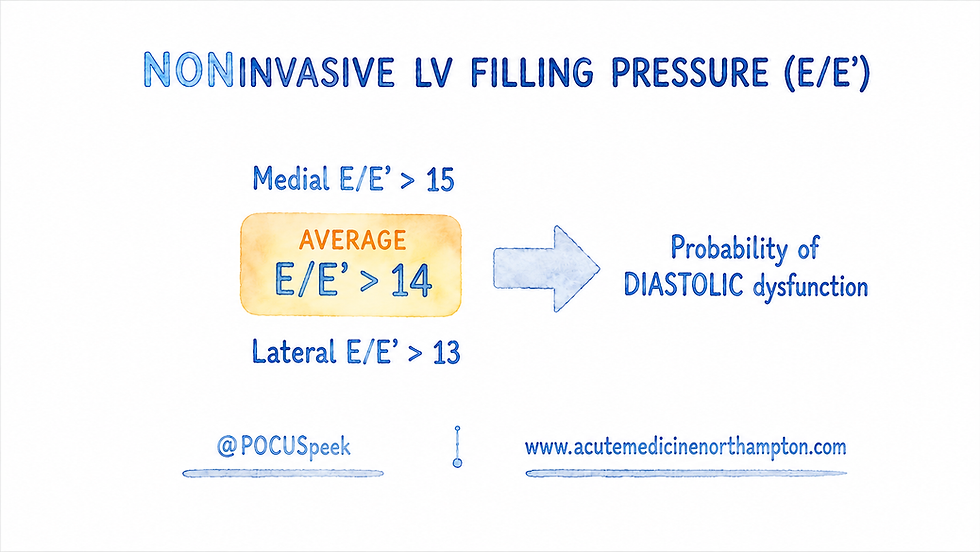
E/e′ ratio is a useful estimate of left ventricular filling pressure (LVFP) and left atrial pressure (LAP)
Average E/e′ < 8 strongly suggests normal LV filling pressure
Average E/e′ > 14 strongly suggests elevated LV filling pressure (*PCWP >15 mmHg)
If only one annulus can be measured:
Lateral E/e′ > 13 or
Septal E/e′ > 15 = elevated filling pressures
Physiology
As diastolic dysfunction worsens:
e′ decreases - impaired relaxation
E increases - rising filling pressures
therefore, E/e′ increases
Important Limitations
Interpret E/e′ cautiously in:
LBBB or paced rhythm
Mitral valve repair/replacement or severe annular calcification
Pericardial disease
Significant mitral regurgitation
Regional wall motion abnormalities
Normal LVEF (less accurate than in reduced LVEF)
Effect of Age
e′ decreases with age
E/e′ may rise slightly in older adults.
However, E/e′ > 14 remains uncommon in healthy individuals of any age and generally supports elevated filling pressures
E/e′ is one of the best single Doppler markers of raised LV filling pressure, but it should never be used in isolation. Always interpret it alongside the full diastolic assessment and clinical context
*PCWP Pulmonary Capillary Wedge Pressure